


 By neha - June 23, 2026
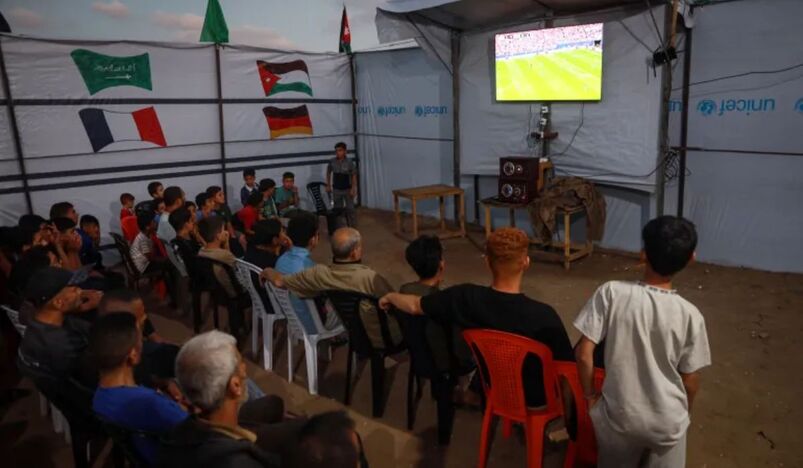
The World Cup is playing. The world is watching. But for Palestinians in Gaza, following the tournament is an act of resistance against despair.
Millions of fans around the globe watch matches live, cheer in packed bars, and celebrate with friends. In Gaza, people walk hours in the dark to find a working screen. Often, they arrive to a power cut.
Watching Highlights After Already Knowing the Score
Sameeh Totah is 43 years old. He sits outside his makeshift tent near Gaza City's Yarmouk Stadium. He holds his phone and plays a match that happened the night before.
Electricity and internet connections cut out constantly. He cannot always watch live. By the time he gets a signal, someone has already told him the score.
"Once you know the result, the joy and excitement are gone," he said.
He still watches. Football gives him a few minutes away from everything else.
"Sometimes I pick up my phone and watch a match just to ease some of the stress," he said. "I want to forget, even for a little while, about the suffering we are living through."
Sameeh is a father of six. He was displaced from his home in Zeitoun neighbourhood. Israel's war on Gaza has now killed more than 73,000 Palestinians since October 2023. His old home sits inside a forced displacement zone. He cannot go back.
He remembers the 2022 World Cup in Qatar. He was still at home. Friends came over. Family gathered. The television worked.
"At least back then, people felt relatively comfortable," he said. "We could gather with loved ones and watch the matches. Despite everything, there was still room for life."
Now he lives in a tent. There is no privacy. There is no comfort.
"Life in a tent is extremely difficult," he said.
A Long Walk to a Closed Cafe
Yousef al-Nuaizi is 21 years old. He has followed football his whole life. He supports Portugal's national team.
This year, watching the World Cup takes more effort than it gives back.
He walked with friends before dawn to reach a cafe showing a match. When they arrived, the cafe was dark. No electricity. The generator had no fuel.
They found another place. They watched for 40 minutes. Then exhaustion won.
"Our lives have changed completely," he said. "There are no basic necessities. Even going to the toilet requires waiting an hour for your turn."
He grew up in the Shujayea neighbourhood. He was forced to leave. He now lives at Yarmouk Stadium as a displaced person.
That same stadium holds a different kind of memory for him.
"I used to come here to watch local football matches," he said. "This stadium held beautiful memories for everyone. Today, it has become a place of displacement instead of a place of joy."
He thinks back to the Qatar World Cup. He and his friends set up a big screen. They brought national flags, coffee, tea, snacks and sweets. They stayed up all night.
"The real passion is gone," he said. "Almost all the passion in Gaza has disappeared after everything we have seen."
He still watches when he can. But not for the love of the game any more.
"I mostly watch to pass the time," he said.
A Cafe Built From Tarpaulins and Wooden Planks
Tariq al-Jadba is 26 years old. He built a small cafe inside the displacement camp where he lives. Flags of competing nations hang from the fabric walls. Football artwork decorates the space.
He opens the cafe for every match. He coordinates with generator owners to secure electricity. He tracks fuel supplies. He plans around power schedules.
Dozens of people gather during big games. But even as they watch, fear sits beside them.
"People come to watch football, but we watch while we are afraid," he said. "Especially during matches played late at night. There is always fear of nearby bombardment or an attack."
Israeli restrictions have choked fuel and electricity supplies across Gaza. Solar panels cannot power the screens through the night. Some matches start before dawn. Generator owners often run dry.
Despite all of this, al-Jadba stays open.
"I have followed football since I was five years old," he said. "Palestinians in Gaza love football. We are a young and athletic society."
He watches what football still does for people in the camp.
"When Arab teams play, the atmosphere becomes lively again," he said. "People here are looking for any space that allows them to escape the reality of war. They want to regain, even briefly, a sense of normal life."
What Football Means in a Time of War
Sports stadiums across Gaza now shelter displaced families. Many have been destroyed. The places where people once cheered and argued over match results now hold tents and grief.
But football has not disappeared. It has changed shape.
It is now a phone screen inside a tent. It is a 40-minute watch before exhaustion sets in. It is a cafe with borrowed electricity and borrowed flags. It is a man in his forties watching yesterday's highlights because last night the internet died.
The World Cup goes on. In Canada, the United States, and Mexico, 48 teams compete in packed stadiums. In Gaza, people compete to find a working screen.
They still watch. That matters.
_20-08-2026_05-08.jpg)
_27-51-2026_11-51.png)
_27-43-2026_12-43.png)



.jpg)
.jpg)

.jpg)


.jpg)
.png)
.jpg)






Leave a comment